


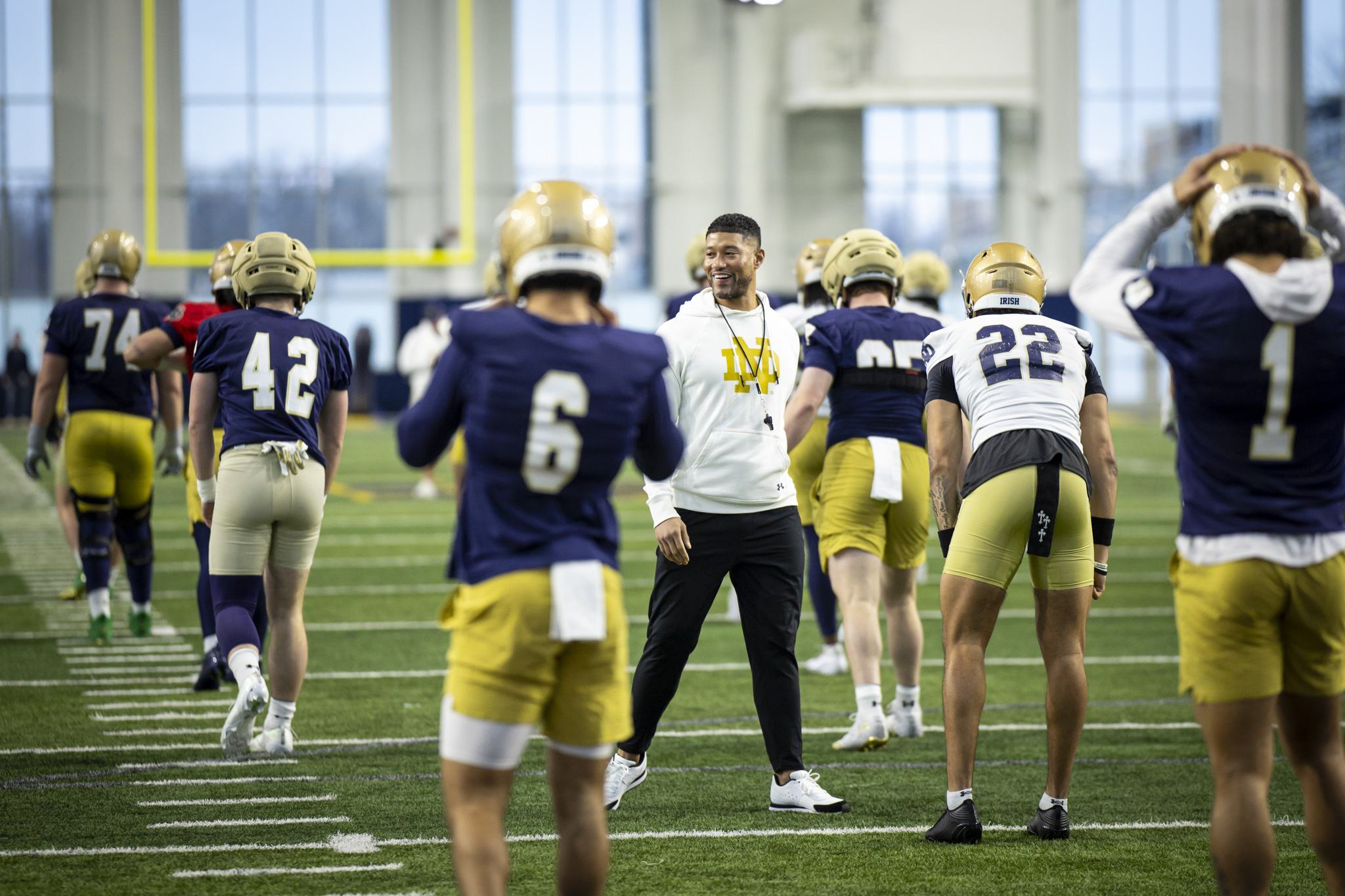
(Photo: Chad Ryan)
Notre Dame spring football is here—and this feels like a roster with clarity, not questions. Here are some early takeaways on the Irish.
The quarterback room looks different this spring—and that starts with certainty at the top. CJ Carr is coming off a spectacular redshirt freshman season, throwing for 2,741 yards and 24 touchdowns. He enters 2026 as the unquestioned starter and an early Heisman candidate. His poise in the pocket and ability to create explosive plays downfield give this offense a clear identity.
The real competition at quarterback is behind him.
Blake Hebert, Noah Grubbs, and Teddy Gerrard will battle for the backup role. Hebert enters his second year in the program, while Grubbs is already on campus getting valuable spring reps. Gerrard won’t arrive until the fall. None of the three have in-game experience, making this one of the more important position battles to monitor through spring and fall camp.
The wide receiver room may be one of the best Notre Dame has fielded in years.
Transfer additions Mylan Graham and Quincy Porter from Ohio State are expected to contribute immediately, while returning playmakers Jaden Greathouse and Jordan Faison provide proven production. Mix in several other talented freshman and young players who will push for playing time and this group has the ability to stretch the field and generate explosive plays consistently.
Running back is one of the bigger question marks—but not a weakness.
Replacing Jeremiyah Love and Jadarian Price won’t be easy, but the room still has a solid core. Aneyas Williams has flashed speed and explosiveness in limited opportunities. Promising Kedren Young is working his way back from an ACL injury, while Nolan James Jr. brings a year of experience after seeing limited action last season. Freshmen Javian Osborne and Jonaz Walton are both highly touted, though their roles may take time to develop.
Up front, the offensive line looks stronger and more cohesive.
An early projection: Guerby Lambert (RT), Sullivan Absher (RG), Joe Otting (C), Anthonie Knapp (LG), and Will Black (LT). Knapp’s move inside to left guard is a notable shift. Center Ashton Craig is expected to regain his starting position at center once he returns from injury. Charles Jagusah remains a question mark following an ATV accident that sidelined him last season, and his availability is still uncertain. Still, this group has the size and athleticism to control the line of scrimmage.
Defensively, Notre Dame has the pieces to be one of the more disruptive units in the country—and it starts up front.
Transfer additions like Francis Brewu, Tionne Gray and Keon Keeley immediately upgrade the Irish along the defensive line, giving them more size, length, and pass-rush ability and should allow Notre Dame to rotate bodies and stay fresh in the trenches. And of course don’t forget Boubacore Traore and Bryce Young. This is a group that should be able to generate pressure without constantly relying on blitz packages—something that can completely tilt a game.
At linebacker, Drayk Bowen anchors the unit with physicality and instincts, giving Notre Dame a steady presence in the middle and the ability to control the run game.
On the back end, Notre Dame’s strength is defined by elite corner play—and it starts with Leonard Moore.
A unanimous All-American last season, Moore gives the Irish a true lockdown corner who can erase one side of the field. That kind of player changes how offenses operate and allows the defense to be far more aggressive elsewhere. Christian Gray complements him with versatility and physicality, capable of handling multiple roles in coverage.
Next to them, Adon Shuler provides range and reliability at safety, while Tae Johnson—coming off a breakout season—looks poised to take another step as a playmaker. Johnson’s emergence adds another layer to this secondary, while Shuler’s presence over the top allows the corners to press and challenge routes with confidence.
This secondary isn’t just talented—it’s layered.
Put it all together, and this is a defense built to dictate terms. Pressure up front, control in the middle, and elite coverage on the outside give Notre Dame the ability to take games over.
Marcus Freeman has assembled a roster with depth, balance, and experience.
Leave no doubt, in 2026, the expectation isn’t development—it’s proof.
Final Byte
If this team stays healthy, the formula is already in place: a quarterback who can win games, a receiver room that can tilt the field, and a defense that can take it away. That’s not a rebuild—that’s a roster built to finish. And in a 12-team playoff era where margins get thinner in December, Notre Dame won’t be asking if it belongs… it’ll be asking who’s left to stop it.