


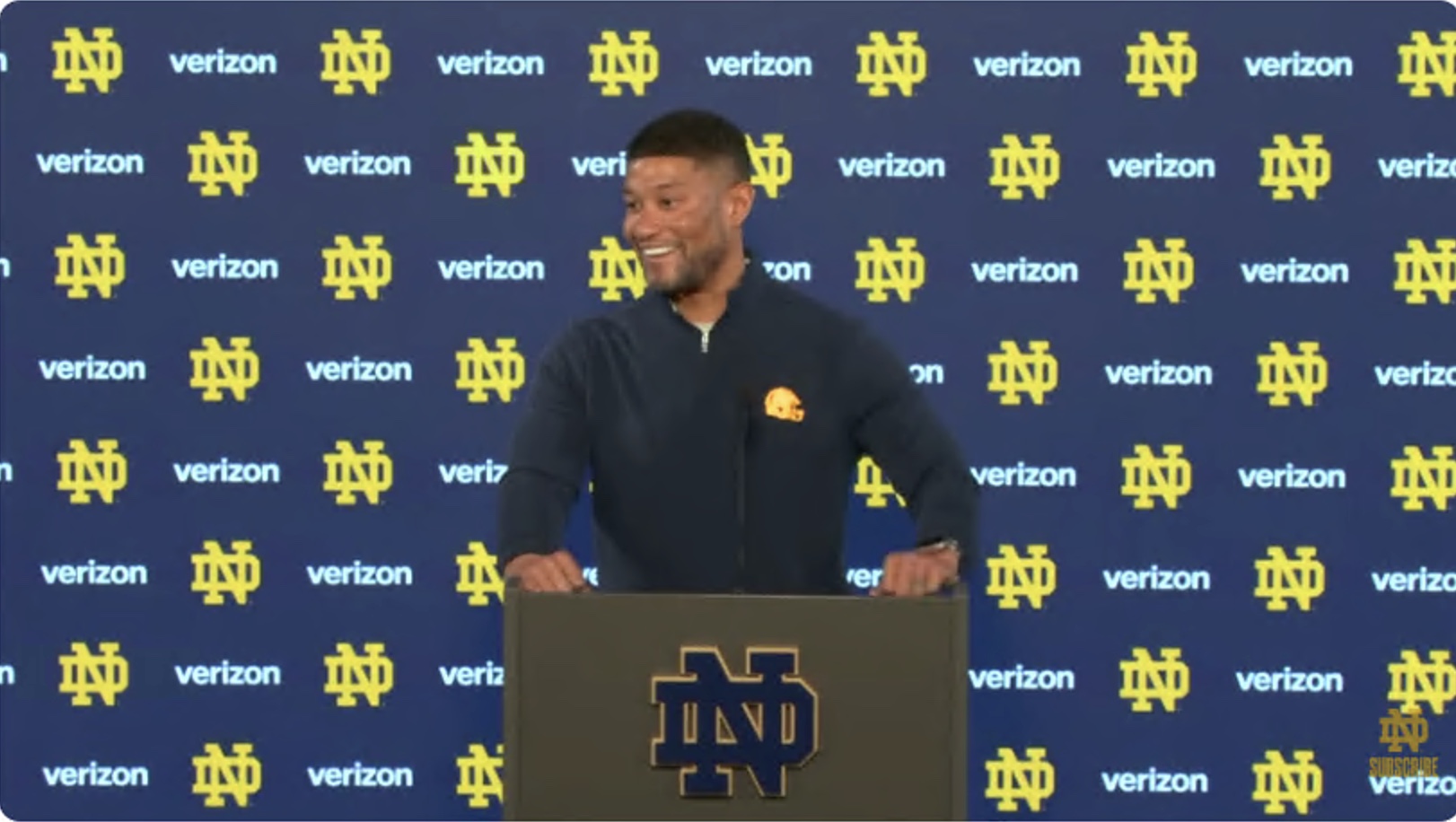
Two days before the start of spring practice, Marcus Freeman faced the media for about 30 minutes and delivered a clear message: this is a more advanced, more connected Notre Dame team — and expectations are rising with it.
That confidence isn’t based on projection. It’s based on time, continuity, and a program that, for the first time under Freeman, isn’t starting over anywhere.
A Different Level of Development — Born From Disappointment
Freeman pointed first to the structure of the offseason — and how much ground this team has gained.
“We’ve never had this much time… We’re at a different level than I’ve previously seen us at.”
That time didn’t come by accident.
Notre Dame’s absence from the playoff created a full, uninterrupted eight-week winter development cycle — something programs playing deep into January simply don’t get. Painful in the moment, yes. But it may prove to be a hidden advantage — especially for a program still building toward elite consistency.
“There’s been a lot of benefits for this group to have those eight weeks of uninterrupted training.”
The tradeoff is real: postseason success builds confidence, but uninterrupted development builds depth — physically and schematically.
Freeman even questioned whether the system itself creates an imbalance:
“Is there a way to shift the calendar so we all get those eight weeks… and don’t feel like you’re not as developed… if you make a playoff run?”
That progress is amplified by continuity — something Notre Dame hasn’t always had.
“You don’t have to start back over… you’re able to really be developed at a different level.”
In practical terms, that means less installation and more refinement — a critical distinction for a team trying to close the gap with the elite tier.
“Choose the Struggle”
Freeman returned repeatedly to a mindset he expects from everyone in the program:
“You’ve got to choose the struggle… choose things that are going to challenge you mentally and physically.”
And it starts with him.
“How can I find ways as a leader… to be uncomfortable every day?”
This is more than messaging — it’s operational philosophy. Freeman is clearly trying to eliminate complacency in a program that has been good, but not consistently dominant.
The emphasis on discomfort is intentional: growth is being treated as a daily decision, not a seasonal goal.
“We Left Doubt”
Freeman didn’t deflect from last season — he owned it.
“Let’s blame the CFP committee… that’s human nature. But we own it… we left doubt.”
That framing matters.
Instead of allowing external narratives to define the offseason, Freeman has internalized the outcome — turning it into a controllable standard.
“Leave no doubt that you made the most of this opportunity you had today.”
The shift here is subtle but important: this program is moving from reacting to results to controlling them.
The expectation now isn’t just to win — it’s to remove debate.
Quarterback Room: A Battle That Matters
While CJ Carr is expected to lead the offense, the most important competition of the spring sits directly behind him.
“You have to name a backup quarterback… that guy has to know, prepare, and take all the two reps.”
The QB2 battle centers on:
- Blake Hebert
- Noah Grubbs
Freeman emphasized that evaluation will be deliberate.
“We have to be intentional about the way we script… to get the right amount of looks or reps.”
That comment is telling — because structurally, backup quarterbacks often struggle to get meaningful evaluation reps in spring. Freeman is making it clear that won’t happen here.
Carr will command the first-team offense, but Hebert and Grubbs will be rotated through situations that simulate real responsibility — not just cleanup duty.
And this isn’t just about depth.
“The competition… is going to go all the way until there is no doubt who that person is.”
This is effectively a two-layer competition:
- Immediate: who is QB2 this fall
- Long-term: who becomes the next starter
With Teddy Jarrard arriving this summer, Freeman reinforced a clear philosophical stance:
“I have a strong conviction… our next starting quarterback… is right here in this program.”
That’s notable in the modern era — a deliberate commitment to development over portal dependency.
Practice Evolution: More Football, Faster
Because of the strong offseason foundation, spring will look different.
“We’re going to do more football… more good-on-good.”
Instead of easing in:
“These guys should be ready for 10, 11, 12 periods to start.”
That shift signals trust — both in the conditioning program and in the players’ mental readiness.
It also increases evaluation pressure. More live periods mean fewer protected reps — and clearer separation between players.
Identity: One Program, One Standard
Freeman continues to push a shared mindset — especially with new players entering the program.
“That wasn’t them. That was us.”
“Put self away… I’m putting family and Notre Dame in front of myself.”
In the transfer portal era, where rosters turn over quickly, this is a critical emphasis. Freeman is actively trying to eliminate fragmentation — ensuring that new players inherit expectations immediately, not gradually.
The Lou Holtz Standard
Freeman’s emphasis on accountability and daily standards was reinforced by a powerful moment earlier in the week — Notre Dame’s celebration of life for Lou Holtz, which brought former players and coaches back to campus.
Sitting in the Basilica, Freeman said the scope of Holtz’s impact was impossible to ignore.
“To realize the impact that that one person had on everybody… I’m grateful that I got a chance to be influenced by him.”
Though he never played for Holtz, Freeman described a relationship that shaped how he handles adversity.
“Every Sunday after a loss, I knew his call was coming… whatever he said in that moment is what I needed to hear.”
That consistency — especially in difficult moments — is what Freeman pointed to as the foundation of leadership.
“Leadership is influence… and the greatest evaluation of a leader is how you lead during tough times.”
And that ties directly back to the present.
Freeman isn’t just invoking Holtz — he’s aligning the current program with that same expectation: steadiness under pressure, ownership in failure, and clarity in standards.
At Notre Dame, expectations aren’t reset — they’re inherited.
And the message remains:
Leave no doubt.
Health Outlook: Encouraging — With One Major Exception
After Freeman spoke, Rob Hunt provided a detailed injury update that reinforces the broader picture: this roster should be largely intact when it matters most.
“Most are trending for an unrestricted summer.”
That’s the key takeaway — spring availability is limited in spots, but fall readiness is the target.
Short-Term / Minor
- Leonard Moore (ankle)
- Chris Terek (foot)
- Jaden Greathouse (hamstring)
“All three… will have a full spring.”
Limited This Spring
- Drayk Bowen (labrum) — non-contact
- Madden Faraimo (wrist) — complex but “98% successful” outlook
- Kahanu Kia (knee) — nearing return
- Tyler Merrill (shoulder)
- Aneyas Williams (elbow) — active but protected
“He’ll get plenty of work… in a really good spot… for the summer.”
These are controlled progressions, not long-term concerns.
Out This Spring (But Trending Forward)
- Ashton Craig (ACL) — “really, really attacked his rehab”
- Kyngstonn Viliamu-Asa (ACL) — “in perfect position”
- Kedron Young — trending toward full summer
- Quincy Porter — expected full for fall camp
The volume is notable, but the timelines are consistent — most are aligned toward summer readiness, which is what ultimately matters for this program’s ceiling.
The Key Concern: Charles Jagusah
“He’s had a bumpy road… it’s a complex injury and a severe injury.”
Jagusah’s recovery is far more involved than a standard injury timeline. What began as a serious humerus injury last summer has turned into a prolonged, multi-stage process.
According to Hunt, that process has included:
- Multiple surgeries following the initial injury
- Hardware failure when the bone did not heal properly
- A subsequent infection that further complicated recovery
“The hardware… failed… the injury would not heal… we were able to identify some infection.”
That infection is a critical factor — and likely the reason healing stalled.
Jagusah underwent another procedure this week involving bone grafting and re-stabilization, and there is renewed optimism now that the infection has been addressed.
“We’re extremely hopeful… we think that the infection was probably inhibiting some of his bone growth.”
But the reality remains:
“His timeline… is undetermined.”
Unlike the rest of the injury report — which largely points toward summer or fall availability — Jagusah’s return will depend entirely on how the bone responds this time.
This is not a scheduled return. It’s an open-ended recovery.
Bottom Line
This wasn’t just a spring preview.
It was a program recalibration.
The playoff snub created time.
That time created development.
Now comes competition.
Notre Dame enters spring:
- Further ahead physically
- More aligned culturally
- Facing real evaluation — especially at quarterback
- And positioned to be largely healthy when it matters most
All of it anchored by one standard:
“Leave no doubt.”
Spring practice begins Friday.
Now the Irish have to prove it.