


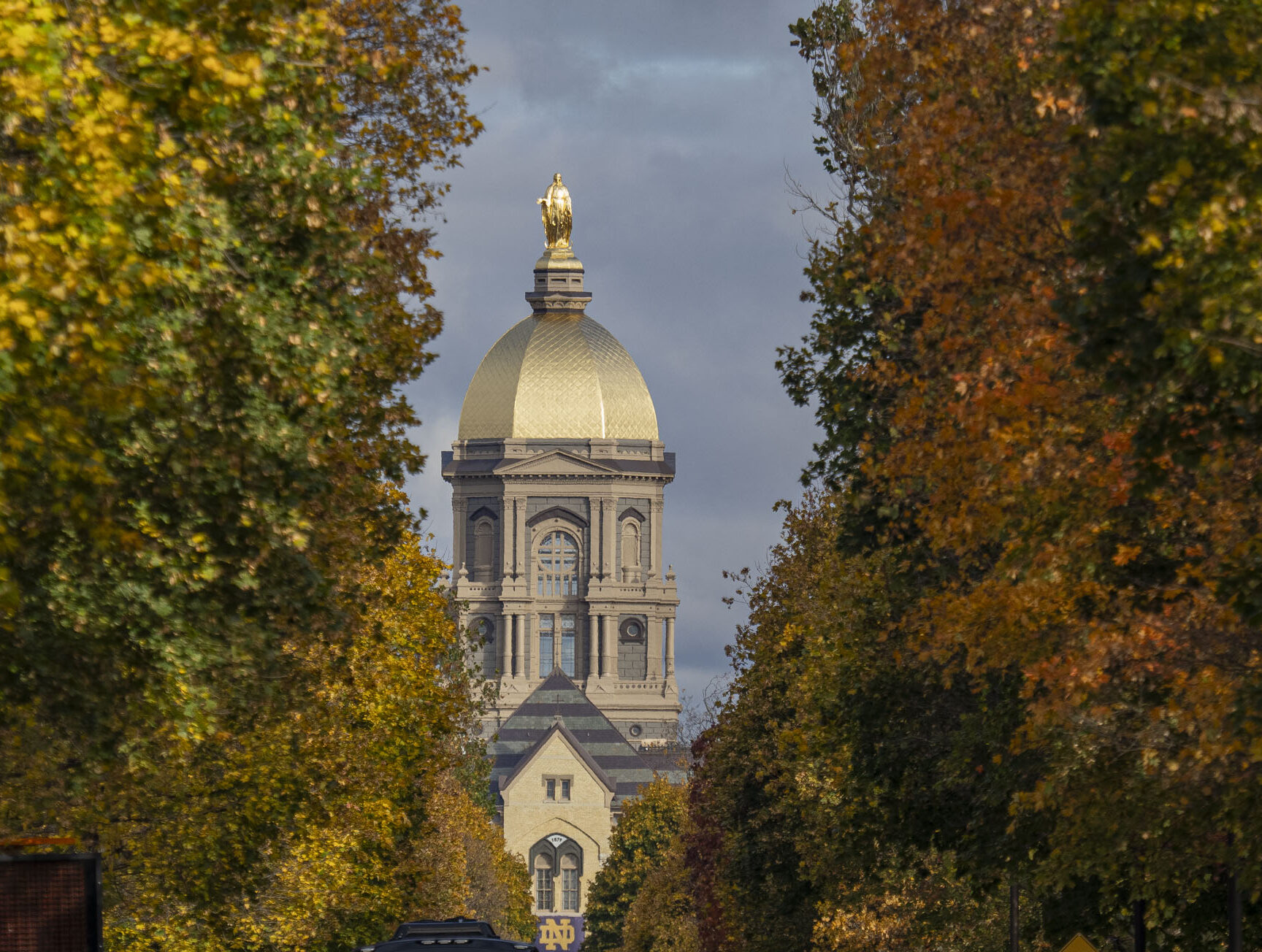
(Photo: Joe Weiser)
Long before diversity and inclusion became part of the national conversation, Notre Dame—and the remarkable partnership between Father Theodore Hesburgh and Ara Parseghian—was quietly helping shape one of the University’s most significant periods of social progress.
Great coaches win football games. The greatest coaches shape lives.
They teach discipline, inspire confidence, and challenge young people to become something greater than they imagined possible. Their influence often extends well beyond the playing field, reaching into classrooms, communities, and sometimes even the course of history.
Few coaches embodied that ideal more completely than Ara Parseghian.
His accomplishments on the football field are well known. In just eleven seasons, Parseghian restored Notre Dame football to national prominence, compiling a 95-17-4 record while winning national championships in 1966 and 1973. His teams produced All-Americans, Heisman Trophy winners, and countless unforgettable Saturdays.
Yet some of Parseghian’s most enduring contributions had little to do with football.
When he arrived in South Bend in 1964, Notre Dame was entering a pivotal period in its history. Across America, the Civil Rights Movement was challenging institutions to examine long-held traditions and live up to the ideals they professed. Notre Dame was no exception. Under the leadership of University President Father Theodore Hesburgh, the University was steadily expanding opportunities for Black students while becoming an increasingly important voice in the national conversation on civil rights.
Parseghian arrived at exactly the right moment.
Although Hesburgh and Parseghian led in very different arenas—one from the President’s Office and the other from the sidelines of Notre Dame Stadium—their leadership proved remarkably complementary. Hesburgh articulated a moral vision for the University, while Parseghian quietly reinforced those same values inside one of the nation’s highest-profile athletic programs. Together, they helped shape a generation of Notre Dame students and athletes while strengthening the University’s commitment to fairness, opportunity, and inclusion.
Neither man accomplished that work alone, nor did it happen overnight.
Notre Dame’s journey had begun years earlier.
The University’s first Black student, Frazier Thompson, enrolled in 1944 through the Navy’s V-12 Officer Training Program during World War II. Thompson earned a varsity monogram in track before graduating in 1947 and later helped develop the pressure suits worn by NASA astronauts. Decades later, while battling cancer, Thompson was asked if there was anything Notre Dame could do for him. His request was simple: a Notre Dame Stadium blanket—a quiet reminder of the lasting bond he still felt with the University.
Progress continued, although not without obstacles.
In 1953, Wayne Edmonds became the first Black football player to earn a varsity monogram at Notre Dame. His experience reflected both the promise and the painful realities of the era. During road trips to Oklahoma and North Carolina, segregation laws prevented Edmonds from staying in the same hotel as his teammates. Rather than divide the squad, Coach Frank Leahy arranged alternate accommodations so the team could remain together. Later that same season, Georgia Tech refused to allow Notre Dame to bring Black players to Atlanta for a scheduled game. Rather than accept those conditions, Notre Dame moved the contest to South Bend.
Those decisions attracted little national attention at the time, but they reflected a university increasingly unwilling to compromise its principles.
When Hesburgh became president in 1952, fewer than a dozen Black students were enrolled at Notre Dame. Over the next two decades, he emerged as one of the nation’s most influential advocates for civil rights, serving on the United States Commission on Civil Rights and famously linking arms with Dr. Martin Luther King Jr. during the Civil Rights Movement. At the same time, he worked to expand educational opportunities on his own campus, increasing scholarship support for minority students and challenging Notre Dame to better reflect the ideals it proclaimed.
That vision found an important ally in the University’s new football coach.
Long before arriving in South Bend, Parseghian had demonstrated that principles mattered more than convenience.
The son of Armenian refugees who had escaped genocide in Turkey, Parseghian grew up with an appreciation for the hardships endured by those who faced discrimination and persecution. Those experiences shaped both the man and the coach he would become.
In 1955, while leading his alma mater, Miami University of Ohio, to a perfect 9-0 season, Parseghian received an invitation to play in the prestigious Tangerine Bowl in Orlando, Florida. There was only one condition: Miami’s Black players would not be allowed to participate.
For a young coach building his reputation, accepting the invitation would have been the easy choice.
Instead, with the full support of Miami University, Parseghian declined the bid rather than leave members of his team behind.
It was a remarkable act of conviction in 1955.
Nine years later, when Ara Parseghian walked onto the Notre Dame campus for the first time as head football coach, he joined a university already committed to moving forward. Together with Father Hesburgh, he would help accelerate that progress—not through speeches or public declarations, but through the everyday example of principled leadership.
That legacy would extend far beyond wins and championships.
Ara’s Way
History often remembers great coaches for championships. The people who played for them remember something entirely different.
Ask former Notre Dame captain Frank Pomarico what made Ara Parseghian special, and he rarely begins by talking about football. He talks about communication.
“The lines of communication ran both ways with Ara,” Pomarico once recalled. “He was very clear about what he expected, but he was always willing to listen.”
That openness created an uncommon level of trust between coach and player. Parseghian demanded discipline and accountability, but his players understood those expectations applied equally to everyone. His consistency—not merely his success—earned their respect.
Pomarico believes many of Ara’s greatest lessons had nothing to do with blocking, tackling, or winning football games.
“He oozed all kinds of information about life,” Pomarico said. “You couldn’t get enough of it.”
Those lessons were often delivered quietly, through example rather than speeches.
One incident from the early 1970s illustrates why so many former players continue to describe Parseghian as “fair.” After repeated disciplinary problems, two Black players were suspended from the football team. At a time when racial tensions remained high across much of America, Parseghian understood that the decision could easily divide his locker room if players believed race had played any role.
Instead of issuing a brief announcement and moving on, he called the team together.
Methodically, Parseghian reviewed the players’ history of disciplinary problems, one incident after another. By the time he reached the fifth or sixth violation, the room had changed. His players understood that the suspensions were not about race. They were about accountability.
The meeting ended not with resentment, but with unity. It was a leadership lesson that Pomarico never forgot.
Perhaps no one better illustrates Parseghian’s influence than Greg Blache.
A walk-on from New Orleans, Blache arrived at Notre Dame in 1967 with dreams of playing for the Irish. Injuries cut that dream short before it truly began. Many coaches would have wished him well and encouraged him to finish school.
Parseghian saw something more.
By the late 1960s, Notre Dame’s commitment to expanding opportunities for Black students under Father Hesburgh was becoming increasingly visible across campus. Parseghian’s football program reflected that same philosophy. He recruited outstanding Black athletes not because he was trying to make a statement, but because he wanted the very best football players. Alan Page, Bob Minnix, Clarence Ellis, Thom Gatewood, Eric Penick, Luther Bradley, and brothers Willie and Mike Townsend became stars during Parseghian’s tenure. More importantly, they became leaders within the program, judged by the same demanding standards as every other player who wore a Notre Dame uniform.
Blache experienced that philosophy firsthand.
Rather than allowing him to drift away from the program after his injury, Parseghian invited him to remain with the team, first helping coach the freshman squad and later serving as a graduate assistant. In 1972, Parseghian promoted him to Notre Dame’s first Black assistant football coach—a milestone that reflected both confidence in Blache’s ability and the broader progress taking place throughout the University.
That decision launched a coaching career spanning more than three decades. Blache would eventually become defensive coordinator for the Green Bay Packers, Chicago Bears, and Washington Redskins, earning a reputation as one of the NFL’s finest defensive minds.
Even after all those years, Blache still refers to Parseghian as “my second father.”
Football, he says, was only part of the education.
Every morning, long before the coaching staff gathered for its 7 a.m. meeting, Parseghian had already read four newspapers. Politics, world affairs, the Vietnam War, the Civil Rights Movement—he wanted to understand what was happening beyond the boundaries of a football field.
“He didn’t shoot from the hip,” Blache recalled. “He researched it.”
That intellectual curiosity left a lasting impression on the young assistant coach. Parseghian believed a leader had an obligation to understand the world his players were living in. He encouraged discussion, welcomed different perspectives, and believed thoughtful opinions were always better than emotional reactions.
Blache also believes Ara’s own upbringing shaped the empathy that defined his leadership. Growing up as the son of Armenian immigrants who had escaped genocide, Parseghian understood persecution in a deeply personal way. His family had experienced hardship, discrimination, and the challenge of building a new life in America.
“He had no tolerance for bigotry and prejudice,” Blache said. “Growing up poor and growing up Armenian, he understood. He understood what it was like for me being Black at Notre Dame and in America at that time.”
That understanding influenced the way Parseghian recruited, coached, and led. He sought the best players regardless of race, expected excellence from everyone, and measured people by their character rather than their background.
Former players often speak of “Ara’s family.” Frank Pomarico has another name for that brotherhood.
He calls them “Ara’s Knights.”
More than fifty years after they played for him, they still gather, still tell stories, and still measure themselves against the lessons they learned from their old coach.
Championship trophies eventually collect dust. Leadership endures through people.
A Legacy Beyond Football
One story neatly captures the unique partnership between Father Hesburgh and Ara Parseghian.
On the eve of Notre Dame’s 1973 Sugar Bowl showdown with Alabama—a game that would decide the national championship—Father Hesburgh made an unusual request of his football coach.
He asked Ara to win.
No explanation. No speech. Just a simple request.
Years later, the significance became clearer. Hesburgh had spent much of the previous decade confronting segregation throughout the South, including public clashes with Alabama Governor George Wallace during the Civil Rights Movement. Whether Hesburgh’s request carried symbolic meaning or was simply the wish of a university president hoping for another national championship, the moment has become part of Notre Dame lore. The following evening, Parseghian’s Irish defeated Alabama 24-23 to claim the national title.
It was one more victory for a legendary coach.
But by then, Parseghian’s impact had already reached far beyond the scoreboard.
More than fifty years have passed since those remarkable years in South Bend. College football has changed dramatically. Notre Dame has changed. America has changed.
Yet when former players gather to remember Ara Parseghian, they rarely begin by talking about championships.
They remember how he treated people.
They remember that he listened before he spoke. That he expected accountability but always tempered it with fairness. They remember a coach who never stopped learning, who read four newspapers before breakfast, who believed informed opinions mattered, and who judged every player by the same standards.
Greg Blache still calls him “my second father.” Frank Pomarico still refers to the brotherhood of former players as “Ara’s Knights.”
That may be the most meaningful measure of Parseghian’s success. Championships create memories. Character creates loyalty that lasts a lifetime.
It is also impossible to separate Ara’s story from Notre Dame’s story.
The University did not become a more welcoming and inclusive place because of one person. Progress never works that way. It took the moral vision of Father Hesburgh, the leadership of coaches like Frank Leahy and Ara Parseghian, courageous student-athletes like Wayne Edmonds, Alan Page, Greg Blache, and countless others whose names are less familiar but whose contributions were no less significant.
Together, they helped move Notre Dame forward.
Like every great institution, Notre Dame has not always been perfect. But during one of the most consequential periods in American history, it chose to grow rather than stand still. It challenged itself to better reflect the ideals it professed, and in doing so became stronger as both a university and a football program.
At its best, Notre Dame has always aspired to educate both the mind and the heart. During one remarkable chapter in its history, Father Hesburgh and Ara Parseghian embodied that mission in different but complementary ways. Hesburgh challenged the University to lead with moral courage, while Parseghian demonstrated those same values every day in the locker room, on the practice field, and in the lives of the young men he coached.
Ara Parseghian never claimed to be a social reformer. He simply believed in treating people fairly. He believed in preparing young men for life, not just football. He believed that leadership demanded character long before it demanded victories.
Perhaps that is why his legacy has endured for so many decades. His record books tell us what he accomplished. The people whose lives he touched tell us who he was. And together, they remind us that the greatest coaches are remembered not simply for the games they won, but for the lives they helped shape.
That may be Ara Parseghian’s greatest victory.