


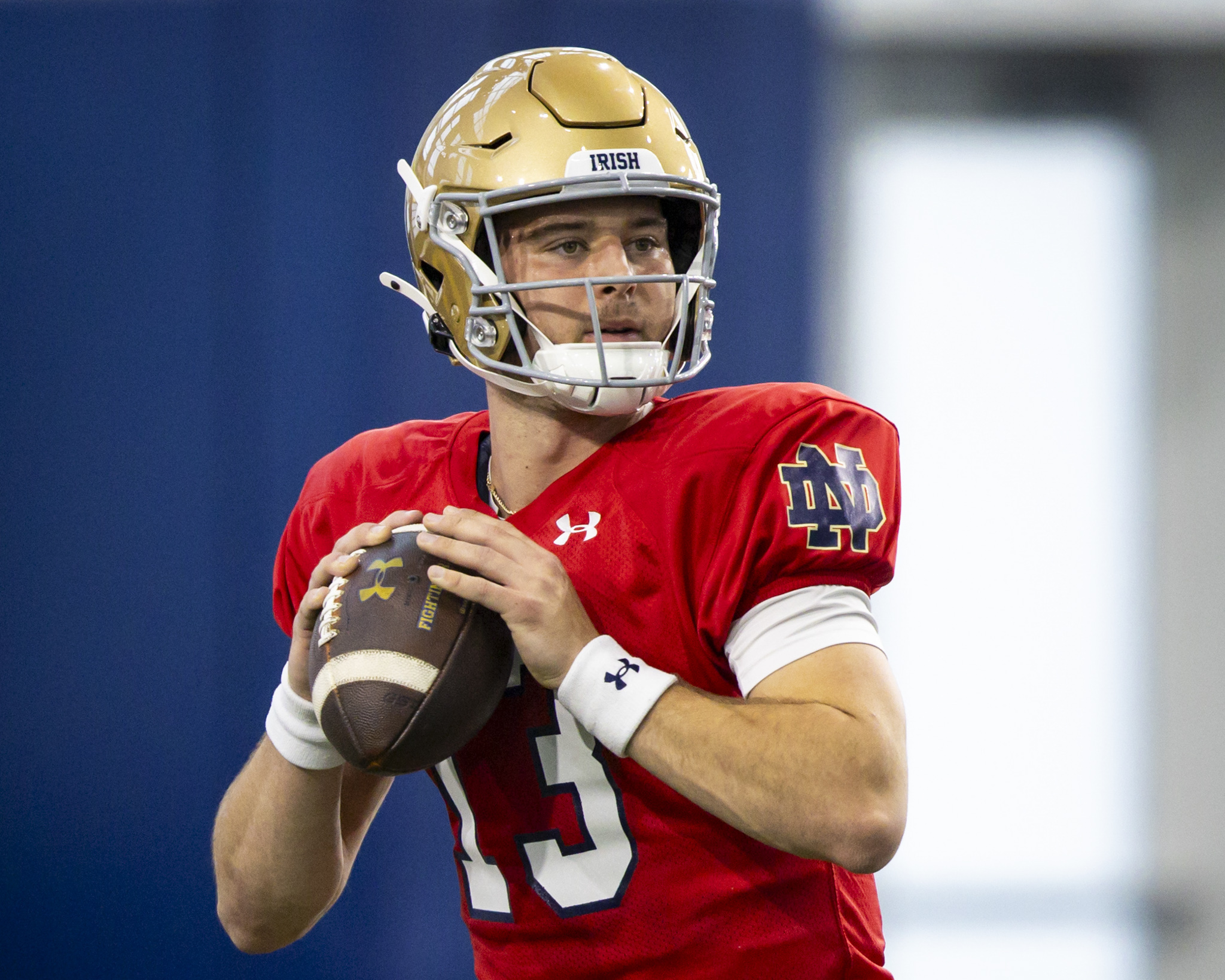
(Photo: Chad Ryan)
When the Notre Dame Fighting Irish take the field Saturday for the 95th Blue-Gold Game, it will feel familiar in all the right ways—and different in one key way.
For the first time since Ian Book, Notre Dame enters spring with a returning starting quarterback firmly in place.
CJ Carr isn’t part of the storyline—he is the storyline.
And that’s the point of this game. It’s never been a final exam. It’s a first glimpse.
The Questions Never Change
Every spring, the questions come fast.
Who’s ready? Who’s next? Where are the answers?
In 2025, it was quarterback uncertainty, skill-position turnover, and whether a new defensive voice could steady things.
In 2026, the questions are different—but just as revealing.
A defensive line supplemented in a big way will be on display, BIG is a key word here, Marcus Freeman referred to the group as “massive” last week. Out wide, this may be one of the deeper receiver groups Notre Dame has fielded in years—transfer Mylan Graham, last season’s leading receiver Jordan Faison now fully focused on football, and a wave of emerging options behind them.
And then there’s the backfield.
Who replaces the Love-and-Price show?
The honest answer—no one. You don’t replicate one of the most dynamic tandems college football has seen in years.
But you can reload.
And the word out of spring practice is that Nolan James, Jonaz Walton, and Aneyas Williams will be just fine… and plenty dangerous.
Different names. Same curiosity.
A Tradition Built to Reveal—Not Decide
The tradition dates to 1929, when Knute Rockne, always part coach and part showman, created a spring scrimmage to promote his team and energize the end of practice.
At first, it wasn’t Blue vs. Gold. It was returning players against outgoing seniors and recent graduates.
That evolved.
In 1937, under Elmer Layden, the game became the “Old-Timers” contest—famously featuring legends like the Four Horsemen in a 7–6 loss to the varsity.
By 1947, it had purpose beyond football, funding scholarships for local students—a mission that continues today through the Rockne Athletics Fund.
In 1953, future U.S. Senator Ted Kennedy even suited up alongside Irish greats like Johnny Lattner and Leon Hart.
By the late 1960s, the format had run its course. Ara Parseghian wanted better competition. The old-timers couldn’t provide it.
So in 1968, the modern era began.
Blue vs. Gold. Teammate vs. teammate.
Same purpose. Cleaner look.
The Clues Are Always There
Spring games don’t give answers.
They give clues.
A throw. A read. A presence.
At the time, it feels routine. Later, it feels obvious.
Because the Blue-Gold Game doesn’t tell you what will happen.
It shows you what might.
2025: The Signal
The 2025 game was framed as a three-man quarterback battle: Carr, Kenny Minchey, Steve Angeli.
All had moments.
Carr had control.
Nothing was decided that day. It never is.
But the tone was set. The competition stretched into summer—and eventually, Carr took the job.
April didn’t decide it.
It pointed to it.
2026: The Confirmation
Now the lens changes.
Carr isn’t competing. He’s established.
And not just inside the program. Outside it, too. He enters 2026 as a Las Vegas favorite for the Heisman Trophy.
That’s not projection anymore. That’s expectation.
So this year, the question isn’t who’s next?
It’s how good can this be?
The Enduring Truth
Through Rockne. Through Parseghian. Through every era in between, the Blue-Gold Game has held its place.
Not as a decider.
As a revealer.
In 2020, even a pandemic could only pause it. In 2021, it returned in limited form. And ever since, the gates have opened again to what they’ve always been: a spring gathering built on curiosity and belief.
Because that’s what this game ultimately feeds.
Curiosity about what’s coming.
Belief in what it might become.
In 2025, it hinted.
In 2026, we know.
And that’s the Blue-Gold Game—it won’t give you the answers.
But it will tell you exactly where to look.