

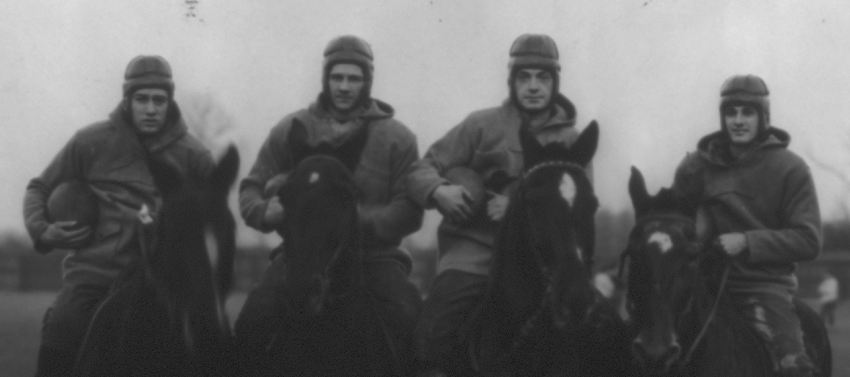
Every Notre Dame fan knows the picture. Some have it hanging in their office. Others have it on a T-shirt, a coffee mug, or framed on the wall of a basement filled with Irish memorabilia. More than a century after it was taken, the image of Notre Dame’s Four Horsemen remains one of the most recognizable photographs in all of sports.
What many fans don’t know is that the famous photo almost never happened.
The story begins in New York City on October 18, 1924. Knute Rockne’s Fighting Irish arrived at the Polo Grounds as underdogs that day against a powerful Army team. Looking at Notre Dame’s backfield, it was hard to imagine anyone describing them in biblical terms. Quarterback Harry Stuhldreher, fullback Elmer Layden, and halfbacks Jim Crowley and Don Miller were all under six feet tall and weighed less than 165 pounds.
Army wasn’t impressed.
By the end of the afternoon however, they probably were.
Led by the brilliant play of Notre Dame’s backfield, the Irish rolled to a 13-7 victory before 55,000 fans and one of the most famous sportswriters in America, Grantland Rice.
During halftime, Notre Dame student publicist George Strickler was in the press box when he made an observation that would become part of college football history. Strickler had recently seen a movie based on The Four Horsemen of the Apocalypse and remarked that Notre Dame’s backfield reminded him of the biblical riders. Whether Grantland Rice heard the comment directly or simply picked it up later has been debated for years. What isn’t disputed is what happened next. Rice sat down at his typewriter and produced what may be the greatest lead paragraph ever written in sports journalism history:
Outlined against a blue-gray October sky, the Four Horsemen rode again. In dramatic lore they are known as Famine, Pestilence, Destruction and Death. These are only aliases. Their real names are Stuhldreher, Miller, Crowley and Layden.
With those words, four football players became legends.
But there was one problem.
Nobody had actually ever seen the Four Horsemen on horses.
That’s where George Strickler enters the story for a second time. Later that evening, Strickler was walking through the Belmont Hotel in New York when he saw stacks of newspapers carrying Rice’s now-famous column. Reading the story gave him an idea. If Rice had created the Four Horsemen with words, perhaps Notre Dame could create them with a photograph.
Before leaving New York, Strickler wired his father back in South Bend and asked him to find four horses. His father, who worked at Notre Dame, located four work horses at a local coal and ice yard and had them ready when the team returned home.
The following afternoon, Strickler gathered the horses, recruited a photographer, marched onto Cartier Field, and interrupted football practice.
Knute Rockne was not amused.
Neither, as it turned out, were the Four Horsemen.
When Strickler asked the players to climb aboard the horses, they refused. At first they offered several reasons. Football players belonged on football fields, not horses. The photographer wanted each player holding a football even though there was only one football in a game. Their practice uniforms were dirty, worn out, and full of holes.
Rockne wasn’t buying any of it.
Already irritated that practice had been interrupted, Rock demanded the real reason.
The truth finally came out. The Four Horsemen were afraid of the horses.
According to stories later shared by Harry Stuhldreher and Jim Crowley, three of the four players had little or no experience riding. The football heroes who had just conquered Army wanted absolutely nothing to do with climbing onto those animals.
Rockne had heard enough. Afterall, George Strickler had gone to considerable trouble to arrange the photo. Practice was being delayed. The players were getting on the horses, and they were getting on them immediately.
As usual, Rockne got the last word and the iconic photograph was finally taken.
Incredibly, only one picture was shot. Photography in 1924 was hardly foolproof, and photographers usually took several pictures to ensure a good result. Yet there was no second attempt, because the “riders” wanted off those horses as quickly as possible.
And that explains something Notre Dame fans have noticed over the years.
Look closely at those faces. These don’t look like four fearless horsemen preparing to ride into battle. They look like four young football players hoping the horses remain calm until the photographer is finished. Don Miller, Elmer Layden, Jim Crowley, and Harry Stuhldreher, just wanted it over.
The entire photo session lasted less than two minutes.
Think about that for a moment.
A student’s observation in a press box. A sportswriter’s unforgettable prose. Four borrowed work horses. An irritated legendary coach.
Four nervous football players, two minutes.
And, more than 100 years later, we’re still talking about it.
Not bad for a photograph that almost never happened.
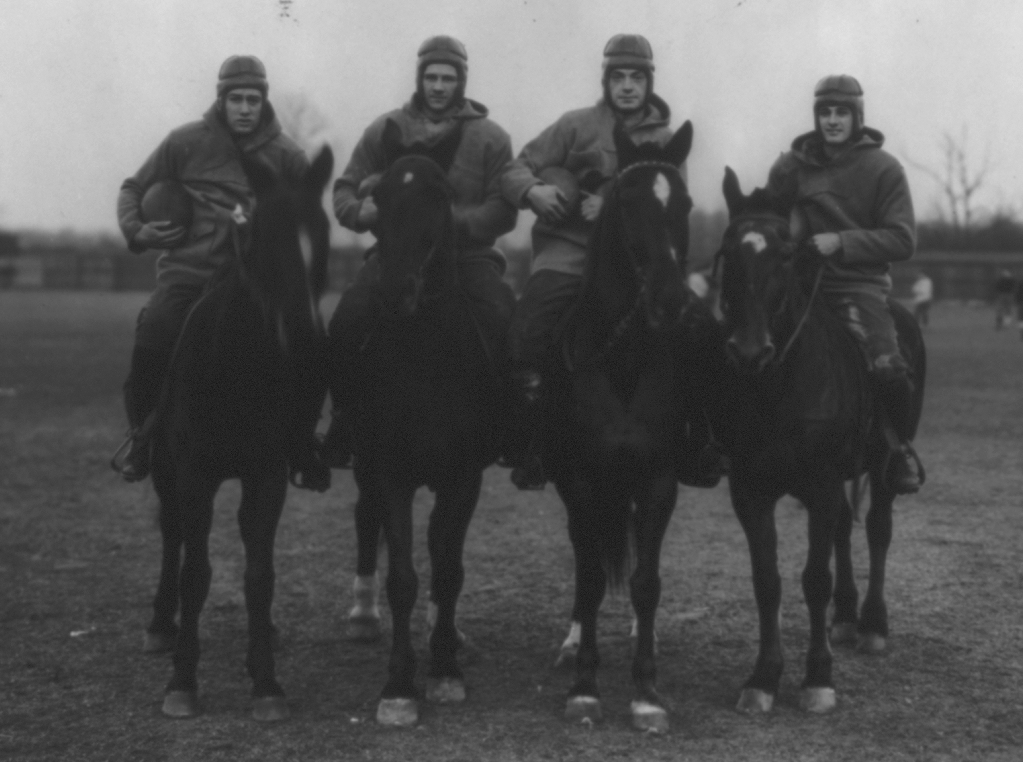
(Photo: George Strickler / Library of Congress / Public Domain)