

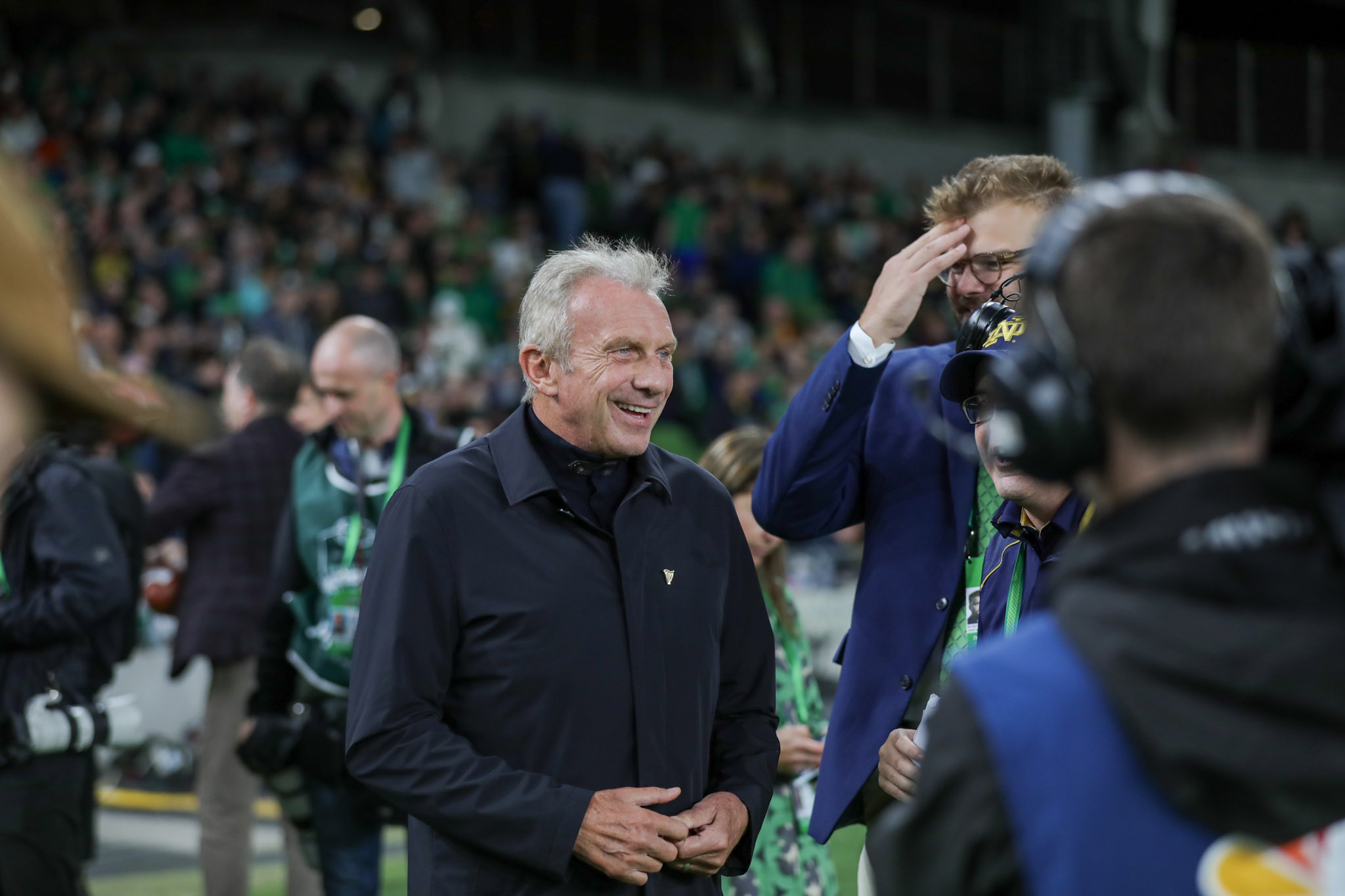
(Photo: AJ Houk)
Joe Montana came to Notre Dame out of Monongahela, Pennsylvania, in 1974. At the time, Ara Parseghian was still the head man in South Bend, and was fresh off national championships in 1966 and 1973. Montana was a promising recruit, but under NCAA rules at the time, freshmen couldn’t play varsity football, so his first year was spent mostly learning the system.
When Parseghian retired after that season and Dan Devine took over, Montana quickly made an impression. Devine later told his wife after spring practice, “I’m gonna start Joe Montana in the spring game.” When she asked who that was, he replied, “He’s the guy who’s going to feed our family for the next few years.”
Still, Devine didn’t think Montana was quite ready to start in 1975 — at least not until he came off the bench late against North Carolina with the Irish trailing 14–6. In just over a minute, Montana threw for 129 yards and led a miraculous 21–14 comeback win. A week later he did it again, rallying Notre Dame from 30–10 down in the fourth quarter to beat Air Force 31–30. The Irish faithful had just met their new “Comeback Kid.”
Montana lost the 1976 season to a separated shoulder but returned in 1977 as the third quarterback on the depth chart. But that didn’t last long. Against Purdue, he entered the game with 11 minutes to play and the Irish down 24–14. Montana calmly threw for 154 yards and a touchdown as Notre Dame pulled out a 31–24 win. Montana never looked back. The Irish won their next nine games, and then blasted No. 1 Texas 38–10 in the Cotton Bowl to claim the National Championship.
His senior year in 1978 brought more drama — thrilling comebacks over Pitt and a near-miss against USC, when Montana led a furious rally only to see the Trojans win on a last-second field goal.
And then came the game that sealed his legend — the 1979 Cotton Bowl, forever known as The Chicken Soup Game.
On a brutally cold day and icy field, things looked bleak for the Irish and their flu-stricken quarterback. By halftime, Houston led 20–12, and Montana’s body temperature had fallen to 96 degrees. Wrapped in blankets in the locker room, he was pale, shivering, and fading fast. Then came what turned out to be something of a miracle cure — a bowl of chicken soup.
Montana returned to the game with 7:37 left in the fourth quarter and the Irish trailing 34–12. He would have to be nearly perfect — and he was. The defense made plays, the offense fed off his confidence, and Montana methodically led the comeback. A defensive score, a Montana rushing touchdown, a pair of two-point conversions, and finally, with no time left, a perfect strike to Kris Haines in the end zone. The extra point was good. Notre Dame 35, Houston 34.
That moment set in stone Joe Montana’s reputation as the ultimate comeback quarterback — a legend in blue and gold.
In his Notre Dame career, Montana completed 52.5 percent of his passes (210 of 400) for 2,905 yards and 25 touchdowns. He also rushed for 273 yards and four scores. Good statistics for his era, but what really stood out about Montana was his ability to deliver wins. At ND, he engineered multiple come from behind wins coming off the bench, and had a 20-4 record as a starter.
Montana next carried his Notre Dame magic to the NFL. He became the face of the San Francisco 49ers’ dynasty, leading the team to four Super Bowl titles and earning Super Bowl MVP honors three times. Over a 16-year career, he engineered an amazing 31 fourth-quarter comebacks and defined what it meant to be “clutch.” He finished with over 40,000 passing yards, 273 touchdowns. In 2006, Sports Illustrated named him the “the number one clutch quarterback of all-time”. Montana was inducted into the Pro Football Hall of Fame in 2000.
Joe Montana — the kid from Monongahela who made calm look heroic — is more than a football legend. He’s a Notre Dame legend. And Joe Montana is this week’s Fighting Irish Preview, All-Time Irish Hero.