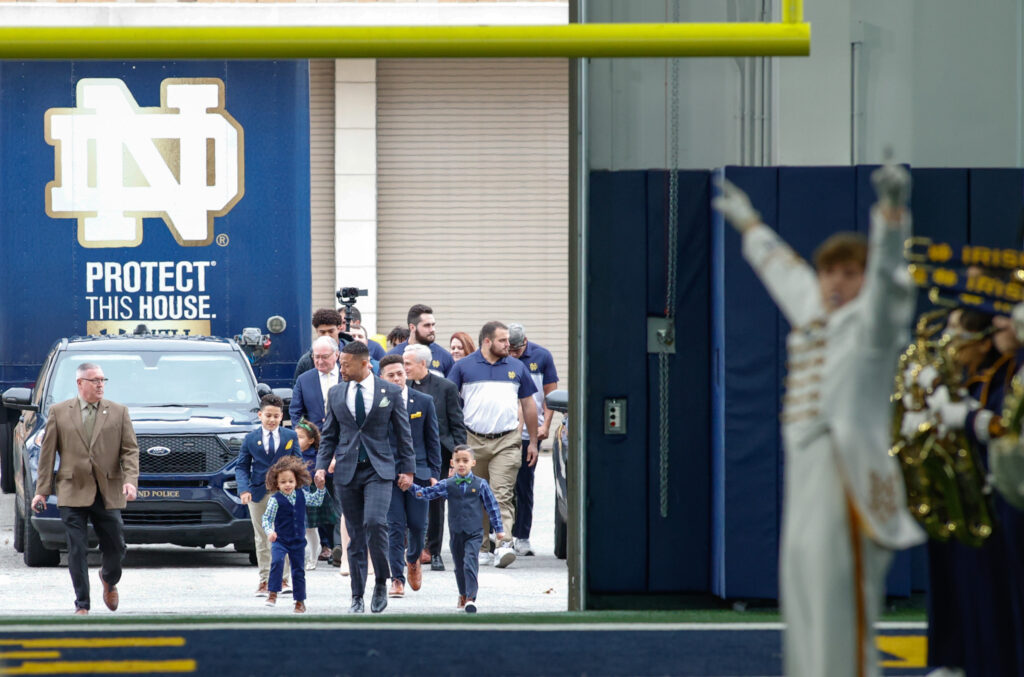
Marcus Freeman enters the field prior to the 2022 Blue-Gold Game. (Photo by Chad Ryan)
Admittedly, as NFL smoke continued to waft and Marcus Freeman remained publicly silent in the weeks since Notre Dame’s emphatic demolition of Stanford to close the 2025 regular season on November 29, there was just enough unease to make even the most rational Irish observer glance over their shoulder. Not panic—Notre Dame fans should have known better than that—but a flicker of nervous curiosity. This is college football in 2025, after all. Silence rarely means nothing.
Then came three words.
“2026… run it back.”
With that understated post—paired with a simple “Go Irish ☘️”—Freeman didn’t merely address speculation. He ended it. Cleanly. Confidently. The message was unmistakable: Marcus Freeman isn’t flirting with the future. He’s building it in South Bend.
The announcement confirms what Notre Dame leadership and those close to the program had been signaling for weeks. Freeman turned down serious interest from the NFL, including discussions with the New York Giants and Tennessee Titans, and agreed to a restructured contract that places him squarely in the top tier of college football compensation. The revised deal extends Freeman through the 2031 season, a clear statement of belief from both sides at a moment when belief is often fleeting.
In a sport addicted to churn—where leverage is currency and exits are applauded—Notre Dame didn’t blink. And Freeman didn’t either.
Sources familiar with the decision say it came down to alignment. Alignment with athletic director Pete Bevacqua. Alignment with the university. Alignment with a locker room that believes it is close—very close—to finishing what it started. Freeman had options. He chose clarity.
“We feel blessed that he’s our coach,” Bevacqua said earlier this month. “I make sure that he knows that he will be where he deserves to be—at the top, top, top tier of college football coaches when it comes to compensation.”
That commitment never wavered, even after a 10–2 season that ended with Notre Dame on the outside of the College Football Playoff looking in. The exclusion was controversial. The margins were thin. Both losses came by a combined four points to playoff teams. Notre Dame’s response, however, was unmistakable: win, reload, and keep going.
The résumé now speaks for itself. Freeman is 43–12 in four seasons at Notre Dame. His .782 winning percentage ranks sixth in school history and fourth among coaches who have led the program for at least 50 games, trailing only Knute Rockne, Frank Leahy, and Ara Parseghian. Those aren’t projections or vibes. They are facts.
The past two seasons—2024 and 2025—were the most successful two-year stretch the program has ever seen, with 24 wins, Sugar and Orange Bowl victories, and a national championship appearance. Along the way, Freeman collected the sport’s most respected coaching honors, including the Paul “Bear” Bryant Award, the Dodd Trophy, and the George Munger Award.
It explains the interest. From the NFL. From major college programs navigating uncertainty. Everyone had eyes on Marcus Freeman.
Notre Dame never lost him.
There is also a Notre Dame–specific truth embedded in Freeman’s decision. He and his wife, Joanna, are raising a large family with seven children, ranging from early elementary school to young adulthood, and South Bend is no temporary stop. At Notre Dame, continuity is not a luxury—it is a value. The university sells formation as much as football, roots as much as results. Freeman fits that ethos. He is not chasing the next rung or testing the market’s temperature. He is building something meant to last, on the field and at home, in a place that has always believed those two pursuits should reinforce one another.
That distinction matters in the shadow of the Golden Dome—after all, Marcus Freeman is no Brian Kelly.
What makes this moment resonate even more is what comes next. Freeman isn’t returning to reset. He’s returning to attack.
Notre Dame carries a 10-game winning streak into the upcoming season. The defense, one of the youngest units in the country a year ago, is now seasoned and deep. The Irish signed a consensus top-five recruiting class in December. And for the first time in Freeman’s tenure, Notre Dame will enter a season with a returning starting quarterback, as CJ Carr leads an experienced roster built for a legitimate championship run.
The window is no longer theoretical. It’s wide open.
“Run it back” did not feel trite, it feels like intent. It came from a coach who understands exactly where his program stands—and how rare that certainty is in modern college football.
Freeman, who turns 40 in January, has become the face of Notre Dame football not by chasing moments, but by mastering them. He connects. He recruits. He develops. He learns. He wins. And he does it while carrying the weight of a program that does not measure itself in press conferences or power plays, but in permanence.
In the end, his message required no elaboration. Three words were enough. No qualifiers. No hedging. No ambiguity. Just confidence rooted in belief—belief in his roster, his staff, his university, and the work well underway.
In a college football landscape addicted to motion, Marcus Freeman chose alignment over escape velocity.
After all, Marcus Freeman is no Brian Kelly.
And in 2026, Notre Dame isn’t starting over.
They’re running it back.